[ Prediction markets that manufacture reality ]
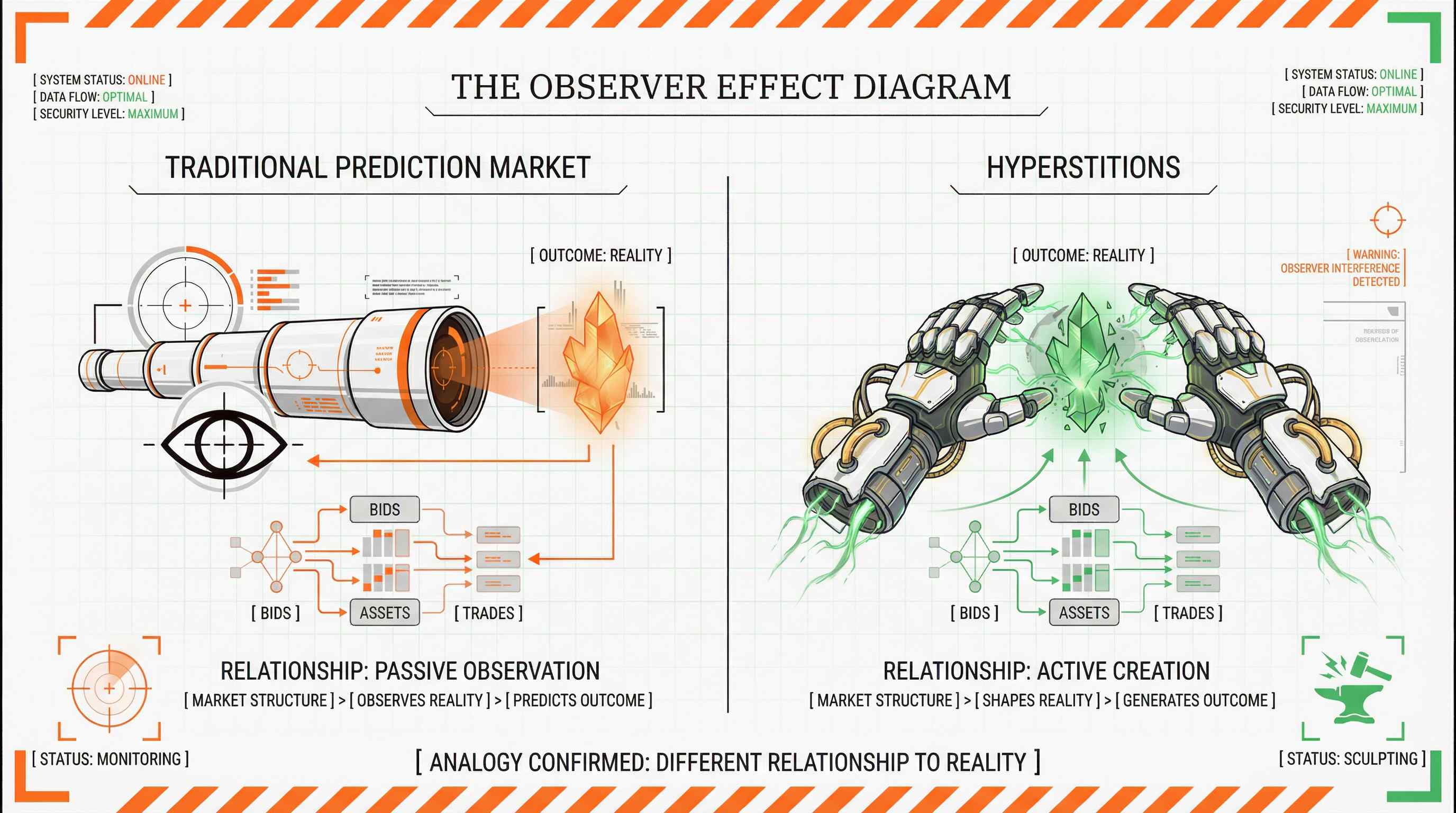
Polymarket proved markets shape outcomes. But those markets are passive observers. We’re building the active version: reflexivity becomes the core feature, weaponized to manipulate the future.
Live on Monad - CA : 0x97401d48a80b15bc7291599e24b590eedcd7ce37
>Hyperstitions turns prediction markets into coordination markets. Buy tokens + bet YES + take action = profit when the outcome manifests. We subsidize the NO side so coordination is always profitable. Think OlympusDAO’s (3,3) meets Polymarket.
A hyperstition isn’t a prediction. It’s a self-fulfilling prophecy with intentional design.

The prediction market runs on $HST. You bet with $HST, you win $HST.
┌─────────────────────────────────────────────────────────┐ │ │ │ Protocol buys NO first (2% emissions) ──► YES is cheap│ │ │ │ │ ▼ │ │ Users buy $HST + bet YES ──► Price moves up │ │ │ │ │ ▼ │ │ Target hit ──► YES wins ──► Emissions + winnings │ │ │ │ │ ▼ │ │ New cycle starts with higher target ◄─────────────────┘ │ │ └─────────────────────────────────────────────────────────┘
> THAT’S IT. Betting YES alone doesn’t move price. But buying tokens + betting YES creates profitable arbitrage: your purchase pushes price toward target, triggers YES, you collect emissions + winnings + appreciation.
Not speculation. [ Manifestation ]
> Hyperstition
> Cycles
> Emissions
> Dynamic Difficulty
Traditional incentive programs fail because they’re static. A protocol offers X tokens for Y behavior, but they’re guessing at the exchange rate between capital and coordination.
Hyperstitional Cycles solve this through dynamic price discovery for incentives. The market becomes a mechanism for discovering who’s willing to coordinate and at what price.
Each cycle operates as an independent market that prices coordination in real-time:
> Cycle Start
> During the Cycle
> Cycle End

The magic is in the iteration. Each cycle generates data:
| Cycle | Target | Subsidy | Outcome | Learning |
|---|---|---|---|---|
| 01 | 50% growth | $20K | [YES] | Subsidy sufficient |
| 02 | 55% growth | $22K | [YES] | Can push harder |
| 03 | 60% growth | $24K | [NO] | Found the ceiling |
| 04 | 45% growth | $30K | [YES] | Higher subsidy = lower target works |
Over time, protocols discover:
This is [ Incentive Price Discovery ] — Something that’s never existed before.

Prediction markets assume reality is fixed and our job is to perceive it accurately. Hyperstition markets assume reality is malleable and our job is to shape it intentionally.
Traditional prediction markets have been used for information aggregation. Organizations like MetaDAO have implemented futarchy models where token holders speculate on which policy will increase token value. But traditional futarchy has a limitation: it aggregates information about outcomes without coordinating action toward them.
You might bet that “launching feature X will increase revenue,” but your bet doesn’t actually help build feature X. The market reveals what people think will work, but participants remain spectators.
Hyperstitions completes the circuit. It’s futarchy with execution built in.
| Traditional | Hyperstitions | |
|---|---|---|
| Participants | Passive speculators | Active coordinators |
| Action | Bet on which policy is better | Buy tokens + Bet YES to manifest |
| Outcome | Accurate prediction | Prediction + Building outcome |
| Mechanism | Information aggregation only | Information + Coordination |
| Result | Policy chosen if market says yes | Outcome manifested by action |
When you bet YES on an outcome, you’re not just expressing a belief. You’re joining a coordination game where your capital and effort align toward manifestation. The market doesn’t just predict which path is better; it mobilizes participants to walk that path together.
Opportunity Markets (Paradigm, 2025) introduced subsidized prediction markets where sponsors provide liquidity to discover information before competitors. The key innovation: strategic privacy enables information discovery without leaking alpha.
Both use subsidized prediction markets, but for different goals:
| Opportunity Mkts | Hyperstitions | |
|---|---|---|
| Prices | Private (sponsor only) | Public (everyone) |
| Goal | Discover opportunities | Manifest outcomes |
| Mechanism | Info flows to sponsor | Coordination between all |
| Subsidy | Sponsor provides liquidity | Protocol buys NO side |
> KEY DIFFERENCE: Making prices public transforms the market from information aggregation to coordination mechanism. Public prices become Schelling points around which collective action organizes.
Hyperstitions uses a Pot-split AMM (PAMM) for its prediction markets. This is a parimutuel-style system with constant-product pricing and virtual liquidity.
> Key Insight
Holding the winning side doesn’t guarantee profit. If too many traders pile in late at high prices, payout per share can fall below what they paid. This creates natural pressure for early coordination rather than late pile-ons.

[ Bootstrapping ]
Duration: ~7 days minimum
We prove the mechanism using our own token price as the target.
This is the (3,3) phase. Everyone coordinates, everyone wins.
[ Permissioned Launchpad ]
After bootstrapping completes
Open to select DAOs and protocols.
[ Full Launchpad ]
After proving permissioned model
Fully permissionless. Anyone can:
At sufficient scale, the prediction becomes the coordination mechanism.
> Protocol Shipping
Uniswap creates a market: “Ship v5 by Q3 2026.” UNI holders buy tokens + bet YES + contribute code/testing/docs. Transforms passive governance into active coordination.
> Mindshare Growth
Market: “Reach #1 in Kaito’s Information Markets Arena.” Community coordinates content creation, engagement, narrative building. Direct profit motive for collective visibility.
> L1 Growth
Monad creates a market: “Will Monad TVL exceed $1B for 48 hours?” MON holders coordinate to manifest: deploy protocols, provide liquidity, onboard users, build tooling. Buy MON + Bet YES for full exposure to success.

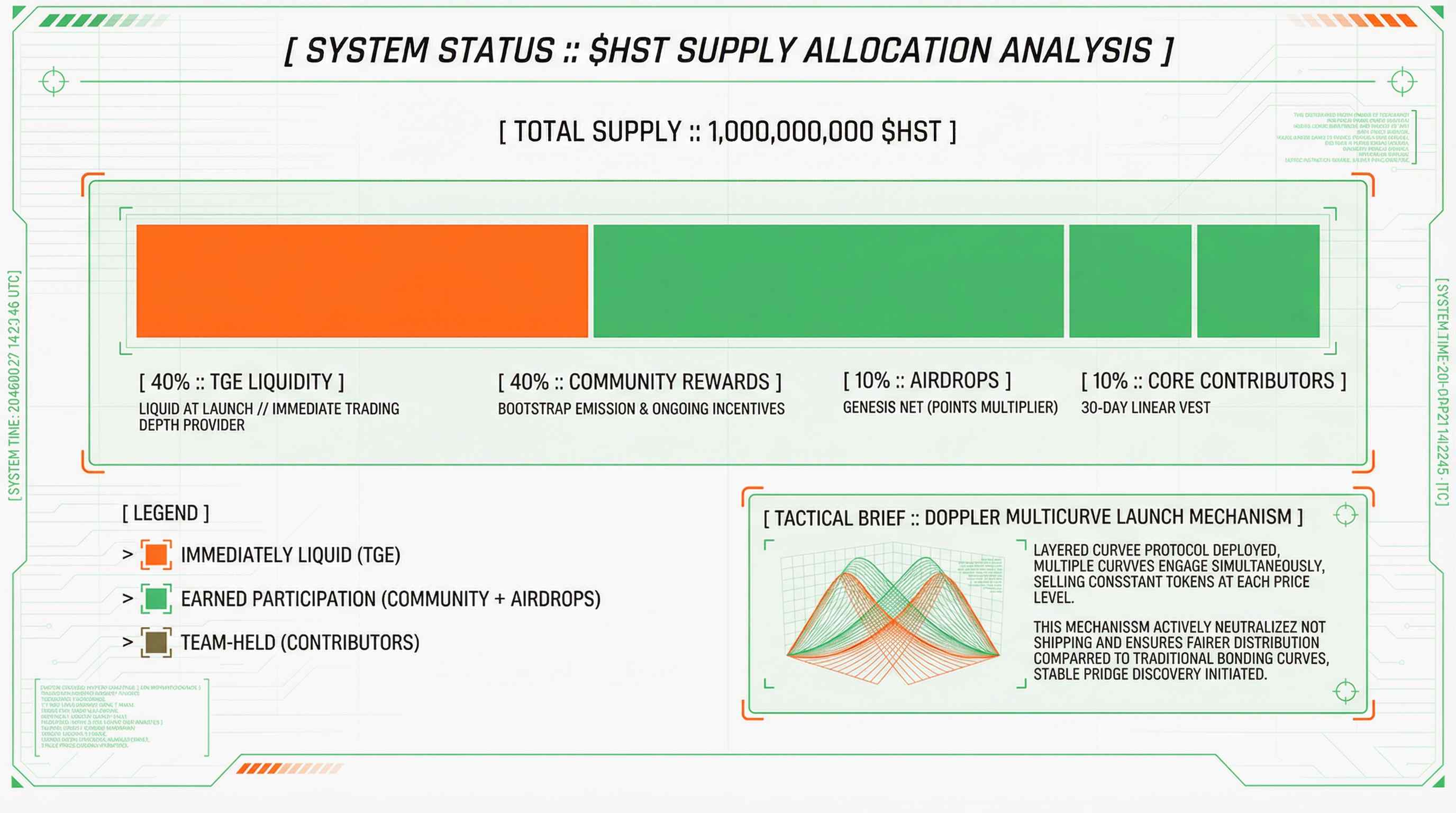
Total Supply: 1B $HST
| Allocation | % | Notes |
|---|---|---|
| TGE Liquidity | 40% | Liquid at launch |
| Community Rewards | 40% | Bootstrap emissions + incentives |
| Airdrops | 10% | Genesis NFT + Coordination airdrop |
| Core Contributors | 10% | 30-day linear vest |
$HST launches on Doppler’s Pure.st platform using Multicurve technology. Traditional bonding curves sell the most tokens at the cheapest prices, which means MEV bots snipe and dump on real users. Doppler Multicurve fixes this by layering multiple log-normal curves that sell a constant number of tokens at each price level. The result: reduced sniping, higher average execution prices, and fairer distribution.
> Genesis NFT Airdrop
An NFT that acts as a points multiplier for your Hyperstitions score. Will be sent to selected communities before launch.
> Coordination Airdrop (10%)
Distributed after the bootstrapping phase based on accumulated Hyperstitions points. Points earned through trading volume, $HST holdings, and social contribution. Genesis NFT holders receive boosted multipliers.
Prediction markets at sufficient scale don’t predict. They execute.

Opportunity Markets let institutions discover opportunities through subsidized private markets. Hyperstitions lets communities manifest outcomes through subsidized public markets.
The token price market is proof of concept. The real product is infrastructure where capital flows to those who engineer reality. For the first time, we have markets where capital can directly shape outcomes rather than merely anticipate them.
That’s the [ Hyperstition ]
>>